THE GALLERY STUDIO THEATRE
It is probably every Theatre Company’s dream to have their own performance, rehearsal and meeting space and certainly it is a dream that we at Gallery have cherished for some time now.
So it was with great excitement that we were pleased to announce that, in 2019, our dream had been realised! We had agreed terms with Ipswich Borough Council to take over what was The New Wolsey Studio, and is now The Gallery Studio Theatre.
We took possession of the building in May 2021 and we hope that you are as thrilled as we are as we embark upon the next exciting phase in the development of Gallery Players.
A HISTORY OF THE BUILDING
St Georges Street (known at one time as Globe Lane), north of the centre of Ipswich, has a long history with connections to the Ipswich martyrs.
Globe Lane took its name from the tavern of that name lower down on the same side, a timber-framed listed building which has survived clearing and has been restored for use as offices.
Near the Globe Henry Davy (1793 – 1865), the artist and etcher, printed and published his many fine views of the antiquities of Suffolk in the first half of the 19th century.


The long-disappeared, pre-Conquest Chapel of St George stood in the street which today bears its name, opposite this very building where St. Georges Terrace now stands.
The Salem Chapel (now the Gallery Studio) was constructed at a time when Ipswich was an important centre of religious dissension. It is an example of a class of building of which there were many but it is the only one to have survived into the 21st century in more or less its original state. It is of considerable architectural significance as an example of a late Georgian, nonconformist chapel. It is of sufficient historical and architectural interest therefore to warrant its grade 2 listing.
Salem, in Genesis Ch. 14, was the kingdom of Melchizedek, priest-king and peace-maker, who blessed Abram after his parting with Lot.
This neat brick-built late Georgian Chapel was built in 1812 for £1200 at the main cost of Joseph Chamberlain, a versatile medical man, and he conveyed it to trustees for the use of Particular Baptists who came from Stoke Green Chapel across the river to relieve the pressure of numbers there. It opened on 11th June 1812 and, at 45′ x 35′, the Salem Chapel was intended to accommodate four hundred people.
(Particular Baptists are a group of evangelical churches that emerged from the English Baptist tradition in the 1630s. They are defined by their adherence to Calvinistic theology, particularly the doctrine of “particular redemption,” which holds that Jesus Christ’s atoning death was for the elect, not all people. This distinguishes them from the older General Baptists, who held to the doctrine of general redemption.)
Chamberlain’s trade card of the 1820’s implies that he had come from Tavern Street to live and work in the house adjoining the chapel to the north. The garden, with its impressive gateway, stood to the north of the house. Chamberlain seems to have varied his professional activities from time to time. He certainly practised as a surgeon, with an apprentice, in the 1830’s, but from 1839 until his death in 1842 he limited his trade to that of a chemist and druggist. The trade card of the 1820’s advertises him as ‘Surgeon Dentist’ and ‘Proprietor and Vendor of the Established Medicines’. Something seems to have kept him outside the main medical circle of the town.
Joseph Chamberlain, surgeon and apothecary of Ipswich, was described as “inventor of several salves and potions. Dispenser of Dr Sibley’s Solar Tincture”

Earlier forms of dissent
Salem Chapel was not, however, the first chapel in the area, for there was a much earlier (probably Norman) predecessor, as the present street name reminds us.
St George’s Chapel was just across the road from Salem, the scene of dramatic dissent in the mid-1520’s when the itinerant preacher Thomas ‘Little’ Bilney spoke against images and pilgrimages here, and was twice dragged from the pulpit by those of his hearers whom he offended. He had previously preached in St Margaret’s church in the town. This was during a preaching-tour undertaken with the Norfolk mass-priest Master Lambert. After being forced to recant he was imprisoned in the Tower of London for a year, and then returned to Trinity Hall, Cambridge for two years in great torment of conscience.
He was eventually arrested by the order of Thomas Wolsey, and burnt for heresy in the Lollards’ pit at Norwich in 1531. The remains of St. George’s Chapel were in use as a barn when they were demolished in 1825 to clear a site for St George’s Terrace. In the 1880’s the house above the Chapel, then in the occupation of Revd F Pollard, Baptist Minister was called Bilney Cottage. By 1901 the Museum had expanded and it’s ‘West Wing’, overlooking St George’s Street occupies the site where the house and gardens had stood, presumably demolished to make way. This would account for why this wall of the Chapel is now rendered rather than finished in red brick.

Baptists at Salem 1812-1865
Nothing comparably exciting occurred at Salem during three pastorates and the half century of it’s main function. Mr Weare served from the opening in June 1813 until John Hartnall arrived in 1819; self-educated, he left a widow and children when he died at the age of 40 in 1825. A subscription for his four children raised £500, an indication of the high esteem in which he was held. Hartnall had two sermons published on the deaths of George III and Queen Caroline (A Eulogy on the Grave; apparently printed in the chapel) in 1820 and 1821, respectively.
Thomas Middleditch (a good Suffolk name) came from Biggleswade to rescue the congregation after the chapel had been closed for almost seven years. He formed a church ‘on the true union principle, the members being Baptists and Independents indiscriminately’. After eight years at Salem he departed for Stoke Green taking others with him. In 1844, the Revd John Gay, a West Country man who was intended for the Wesleyan ministry, broke with that denomination and took on the Salem pastorate, at which point the stricter Baptists in the congregation withdrew, but so great was the growth of the Salem following under its forth minister over the next two decades that a new and larger chapel had to be opened at the corner of Crown Street and High Street in 1865 for John Gay and his flock.
The Chapel was enlarged under the tenure of both Middleditch and Gay, it was extended to the back to create a second balconied area on the upstairs.
Yet another group of Baptists from Stoke Green took over Salem in the late 1860’s. The chapel was still in use in 1876 when Mr J Manning was the pastor.
It appears that this was the final period of use as a place of worship, as by 1881 it had become a furniture warehouse.
Sketches of the Ipswich Pulpit at Salem Chapel
From 1857 to 1861 preachers of all denominations in Suffolk dreaded the arrival, incognito, of two Suffolk Chronicle journalists, Richrad Gowing and Herbert Wright who posed as casual members of the congregation. (Innocent strangers to churches and chapels would often have been surprised to be greeted with suspicious looks.) The Suffolk Pulpit column would describe everything from the state of the building, the size and condition of the congregation, the appearance, manner and vocal talents of the preacher but, worst of all for him, his sermon would be subjected to close analytical critisism. The two men were never detected in over 170 visits and, even when at Woodbridge Friends Meeting House, not a word was spoken: 3000 words were printed. The series had begun with the Ipswich churches and chapels, and John Glyde junior, who himself attended the Friars Street Unitarian meeting, was the spy in the pew. He visited John Gay and the Salemites on 22 September in 1857 and here are excerpts from his sketch:
The congregation…. which consists chiefly of members of the working classes, is at the present time a numerous body, desiring and seeking a larger chapel for worship.
Gay… is a preacher who appeals to the feelings, the emotional tendency being extremely predominant in his teachings. A fresh faced man, about 33 years of age, with none of the priestly air about him. Mr Gay is all sunshine. He greets you with a warm smile and a fervent shake of the hand, and he looks sometimes as if his heart was a fountain of joy and gladness playing as spontaneously as the song of a blackbird. To judge him fairly, you must take his heart rather than his head, … his composition… is of more practical use with the class of persons he has to deal with, that the most polished manners and cultivated intellect.
Mr Gay is by no means a tame preacher. His gesticulation is liberal, his manner exciting, and his language plain. What the rev. gentleman deems truth is ceaselessly proclaimed, and he gives but little formal reasoning in favour of it. The emotional tendency is son much in the ascendant, that the passions are strongly moved, and occasionally become so excited, as to scarcely bear control, and in his endeavour to adapt his instruction to the popular comprehension, he is apt to descend to bad taste. As a preacher, his most conspicuous trait is strong memory, and his great failing diffuseness. He hammers out an idea until it is as thin as gold leaf, and is fond of using an abundance of phrases expressive of the same idea. He preaches extemporaneously and… is not always successful in the choice of words.
The congregation under the rev. gentleman’s ministry is too large for the building, and the want of good ventilation makes it very uncomfortable on a summer’s day. The numerous attendants… join in the singing very heartily, and the Sunday School is in a very flourishing condition. The reverend gentleman’s stipend is, we believe, only moderate, with so large a congregation, surely more could be awarded to their minister. Mr Gay has for many years been a staunch teetotaller.
The Chapel’s cessation as a place of worship
It appears that, by 1881, the chapel had become ‘PHILLIPS & SON FURNITURE DEPOSITORY’. This was an outpost for their cabinet making, upholstering and undertaking business in St Matthews Street. Their tenure lasted until 1915 and until the bricks were cleaned in the early 1990’s evidence could still be seen from large black letters above the door.
The chapel was given to the town in 1928 by Alderman William Francis Paul. It was then used as a store and carpenters’ workshop. Latterly it became a store for Ipswich Museums.

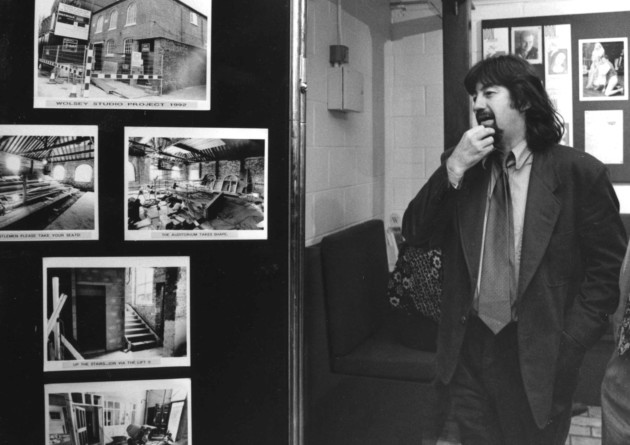
After the 1950’s it appears the building was empty and a little neglected and was in danger of being lost completely. Remedial work was done to strengthen the structure. Then, in the early 1990’s, the towns Wolsey Theatre (and its Artistic Director Dick Tuckey) with the support of it’s owners, Ipswich Borough Council, were given permission to convert it to a studio theatre of around 100 seats to complement its larger ‘main house’ just down the road on Civic Drive. It was opened in 1992 by Ipswich ‘native’ Sir Trevor Nunn and over the next 27 years, had an important role in the Wolsey’s, and its reincarnation the New Wolsey’s output. In 2019 the New Wolsey handed back the lease to Ipswich Borough Council and this is where we became involved! After short negotiations IBC agreed terms with us to take over the lease and we were due to get the keys at the end of March 2020. Unfortunately global events intervened and it was another 14 months until we finally moved in on the 14th May 2021. The Mystery of Edwin Drood was our first show in September 2021.
We are so excited to be keeping the Studio as a live theatre venue and look forward to welcoming you there soon!
(Gallery Studio Theatre may be available to hire, our own use allowing. So if you’d like to enquire about hiring a space for corporate events or performances etc please contact us via [email protected])